
Michigan Property Value Fields Have Different Jobs
One Michigan property card can carry several amounts beside a single parcel. Read every label as written. Calling each figure a market value is the fastest way to misread the card. Assessed Value and State Equalized Value belong to the tax assessment. Taxable Value is the base for millage. A recorded sale price is the amount reported for a transfer. The numbers can differ with no data error anywhere in the record.
| Value type | What it means | Where to read it |
|---|---|---|
| True Cash Value (TCV) | Assessor estimate of usual selling price | Local assessment card or notice |
| Assessed Value (AV) | Generally 50 percent of TCV before equalization | Assessor roll; state or county report |
| State Equalized Value (SEV) | Assessed value after county and state equalization | Assessor roll and State Tax Commission reports |
| Taxable Value (TV) | Generally the lower of SEV or capped value, subject to transfer rules | Local tax roll for its stated year |
| Sale price / consideration | Reported amount for a transaction, not an automatic TCV | Transfer affidavit or deed-related record |
Michigan Treasury's property-tax framework and State Tax Commission guidance rely on these distinct labels. A comparison only means something when the tax years and value types match. A taxable value from one year cannot sit beside a deed's sale price from another and pass as a market estimate.
Michigan's Assessment Level Is Not the Sale Price
Michigan's uniform-assessment rule generally sets Assessed Value at 50 percent of True Cash Value. TCV is an assessor's estimate of the usual selling price. It is not a promise that the parcel would fetch double its assessed figure. Equalization can adjust AV to SEV. The factor is often 1.0000, but the field labels stay separate on the record.
Treasury cautions that a sale price is not the presumptive TCV. The assessor must value a parcel with the same method used for comparable property. The assessor may not simply set AV or TV at half of the amount paid. A reported sale can inform the assessment process. Yet it remains one transaction inside a broader valuation method. When a local card displays a value ratio, keep its year and label with it. The method may differ from a private appraisal. Such an appraisal may be made for a sale, loan, estate, or repair decision.
Michigan Taxable Value Can Trail SEV
Proposal A's cap means Taxable Value can sit below SEV. This holds even when the parcel record is complete. Capped Value is recalculated each year under statutory limits. Physical additions or losses can move it too. The local tax bill applies millage to TV. AV and SEV remain separate measures in the assessment record.
A transfer of ownership can uncap taxable value under Michigan law. This is subject to statutory rules and exemptions. The year that change appears depends on the transfer and the local assessment cycle. A prior owner's taxable amount is not a forecast for a new owner's next bill. The Treasury transfer guidance explains the ownership-change rule. Detailed bills, exemptions, and appeal steps belong with the local assessor or treasurer. These are covered in the Michigan property-tax records section.
Sale Price Is a Separate Michigan Record
The amount paid at closing can appear in a transfer filing or a deed-related record, while the assessor card shows the roll's valuation fields. Form 2766, the Property Transfer Affidavit, records the transfer date, purchase price, seller, buyer, local unit, parcel number, and legal description when a PIN is not available. The form goes to the local assessor within 45 days.
The transfer amount is not automatically the market estimate, assessed value, or taxable value. A non-market transfer, a partial interest, a land contract, or another recorded instrument may not match a simple open-market sale. Read the deed type and transfer fields before treating a number as comparable evidence. Michigan's Form 2766 gives the filed field names. Use the county Register's instrument and the local card together when checking which transaction a sale field refers to.
Read Michigan Assessment Fields Together
A local assessment card can separate land value, building or improvement value, classification, PRE percentage, taxable value, sale date, and tax year. The exact field list depends on the municipality. It also depends on its portal. BS&A is a common platform in Michigan. Still, a portal's presence does not guarantee that every local card exposes the same history. It does not guarantee the same reports either.
| Card field | What it helps answer | Check beside it |
|---|---|---|
| Land / improvement | How the assessment is split between site and structures | Tax year and any sketch or physical-change note |
| AV / SEV / TV | Which assessment measure the card displays | Label, year, and equalization context |
| PRE / exemption | Tax classification or exemption status shown by the roll | Current assessor record and filed affidavit |
| Sale / transfer | A transaction date or reported consideration lead | Deed, Form 2766, and instrument date |
PRE is a tax-status field, not proof of who occupied a property on a given day. Likewise, a land and improvement split is an assessment record, not a contractor's replacement-cost estimate.
Michigan Value Reports Need a Tax Year
Michigan's State Tax Commission links county SEV and taxable-value reports dating from 2008 to the current year. An online venue covers 2013 forward. These reports can reveal countywide assessment patterns. They do not replace the individual local parcel card. Statewide reports may use a county level of detail rather than a street-address search.
Keep a tax-year label next to every number you copy. Assessment notices and the annual roll reflect a valuation date and an applicable cycle. A portal may refresh its display after the roll is certified. So note the update or certification field when one appears. The State Tax Commission valuation page routes readers to current and archived reports. It offers a useful trend check without presenting a private market appraisal.
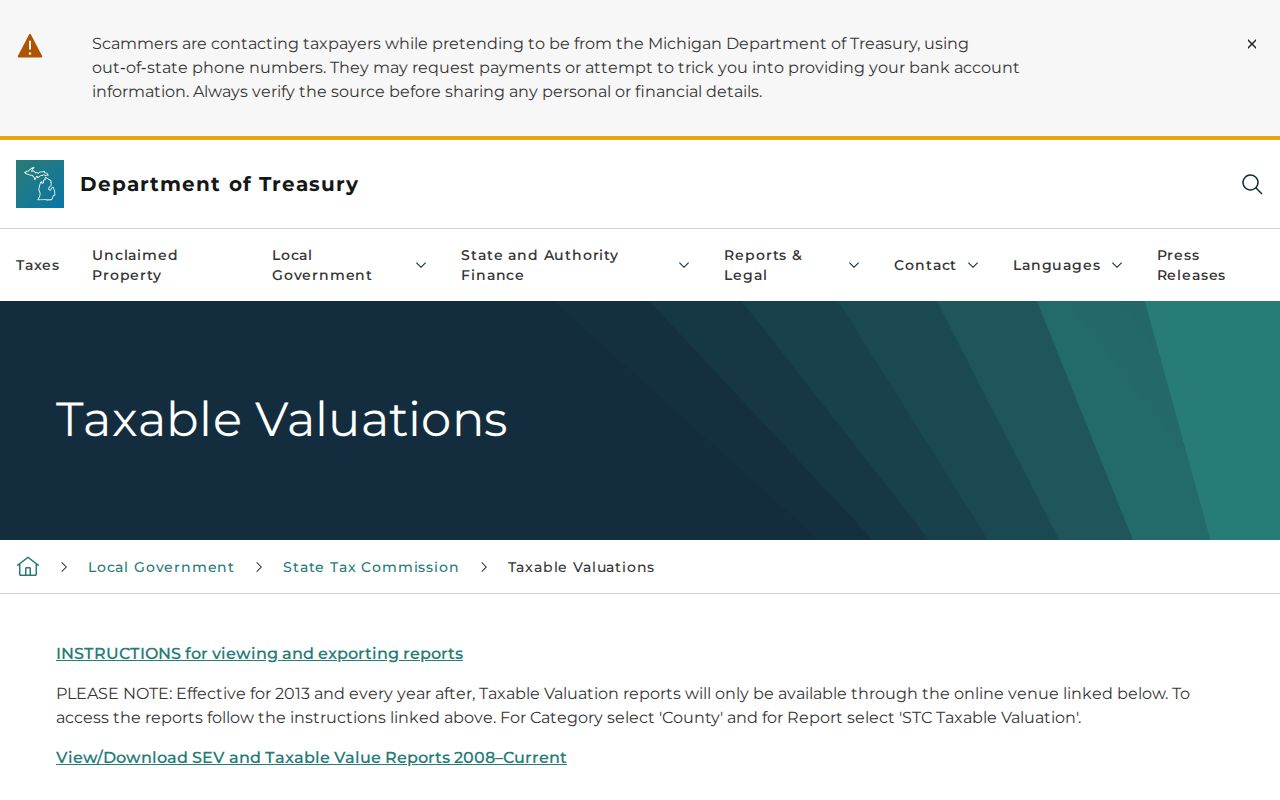
Use a dated county report to understand the roll's scale; use the local assessor record for a parcel-level question.
Michigan's Annual Roll Is a Snapshot
Michigan's local roll gets its values from December 31. That date falls in the year before the assessment year. That single fact explains most date puzzles. A sale, a transfer affidavit, and a parcel card can all show different dates. Nothing is wrong with that. The state also sets no fixed number of days for a portal to refresh after a closing. Owner and sale-field labels differ from one local system to the next.
Trust the tax year or roll date printed beside the value. A recent transfer may seem missing. The recorded deed is probably newer than the annual card. A reporting difference alone doesn't mean one record is wrong. Pull the underlying transfer and confirm against the local assessor's current roll.
Look Up a Michigan Property Value
Start from the parcel, then read the assessment labels on its local card. Michigan has no statewide public owner-and-address assessment portal. A county or local assessor can supply parcel-level values. So can a participating BS&A site or a county tax system. For a general route to the right property search, use the Michigan property search steps. Keep the county name handy. Write down the parcel number before you go further.
- Search the address or parcel/PIN in the local assessor portal and confirm the taxing municipality.
- Copy the value field exactly as labeled, along with the tax year, assessment date, and any update notice.
- Separate AV, SEV, TV, TCV, and any sale-price field instead of combining them as one estimate.
- Check the latest deed or Form 2766 if a transaction amount or transfer date is relevant.
- Use State Tax Commission reports only as county-level context, then ask the local assessor about a parcel-specific discrepancy.
- Assessed Value
- Generally one half of True Cash Value under Michigan's assessment rule.
- Market estimate
- An assessor's TCV estimate, not a private appraisal for a sale.
- Taxable Value
- The roll figure used with millage, generally capped below SEV unless transfer rules change it.
- Sale consideration
- The transfer amount reported in a deed-related filing, not automatically market value.
What a Michigan Assessor Value Cannot Tell You
A Michigan assessor's figure exists for the assessment system and nothing else. It is not a sale-price promise, a private appraisal, or a guarantee of current condition. It may sit on a prior roll date, a capped taxable amount, a transfer-related change, or a local field that has not refreshed yet.
Assessment is not a market appraisal. An assessed value is used in Michigan's property-tax framework and may differ from what a parcel would sell for. For a transaction or lending decision, use a qualified appraiser and current comparable evidence.