
Michigan's Owner of Record Field
Finding the current owner of a Michigan property means checking local sources. No single statewide owner database exists. Begin with the assessor's owner or taxpayer field and note the roll year beside it. Then compare that name against the newest recorded deed for the same parcel. Local offices update their tax cards on their own schedules. A name can show up in one record before it appears in another. Many people search Michigan property records by county for exactly this reason. Keep in mind that a mailing label may differ from the site address. Neither field alone proves residence or legal title.
| Owner or taxpayer | Copy the exact label and name from the local assessor card. |
|---|---|
| Mailing address | Tax-notice address, if displayed; it may differ from the property location. |
| Situs address | Address assigned to the parcel, if shown in the local record. |
| Tax year or roll date | Use the year or last-updated date printed on the card. |
| Transfer or sale date | Record only if a local card displays one; compare it with the deed. |
| Deed reference | Use the county recording number or book/page shown in a linked record. |
Not every card carries every field. Treat any list as a checklist, not proof that Michigan portals share one layout. Remember the distinction: the owner-of-record field is a roll entry, while a recorded deed is the instrument that documents a conveyance. Neither label tells you who occupies the property.
Why Michigan Owner Records Can Lag
Michigan's local roll is assessed as of December 31 for the following year's assessment. It is an annual snapshot, not a live deed feed. A closing and a recorded conveyance can therefore be newer than the owner label visible on the next public tax card. When dates differ, carry both forward rather than silently choosing one as the only current answer.
There is no single statewide number of days for local processing or portal refresh after a transfer. County, city, township, and village systems set their own data practices. The assessor's tax year or updated date is the evidence for the roll's timing; the county recording date is the evidence for the deed's timing.
For a current result, report both timestamps: the roll year or update date, and the latest recorded conveyance date. If the public card lacks a date, say that it is not shown and ask the local assessor instead of inventing a refresh interval.
Use the newer record date. A tax roll can lag a recent transfer. Compare it with the latest recorded deed, which may show a newer conveyance than the assessor card.
Michigan's 45-Day Form 2766 Rule
A buyer, grantee, or transferee must file Property Transfer Affidavit Form 2766, also called L-4260. The filing goes to the local city, township, or village assessor within 45 days of a transfer. The form captures the transfer date, purchase price, seller, buyer, and local unit. It also records a property identification number. No PIN available? It asks for the legal description instead.
The affidavit gives the assessor key information. That information is used to update the parcel record and assess the transfer. It does not set any public-portal refresh date. Filing duty, office processing, deed indexing, and the annual roll each run on separate clocks. A new owner's form may be filed early. The next tax card may not show the updated name until later.
A new conveyance may already be recorded. The local tax roll can still list an earlier owner. That distinction matters. Use the state Form 2766 for the filing rule. Then ask the local assessor when the card was last updated.
Michigan Owner Labels Are Local
Field labels vary by system. A participating BS&A card may say Owner, Taxpayer, Owner Name, or Property Owner. Other county portals prefer Owner of Record, Taxpayer Name, or Deeded Owner. Michigan does not require one statewide display label. Quote the exact field name with the portal and year. Do not normalize every entry to the same wording.
The name can also sit beside a mailing address, exemption, classification, or parcel sketch. This depends on the local system. Treat those as separate data points. A tax value or exemption entry is not a deed. And a card's field layout says nothing about how a grantee is vested. The vesting appears in the recorded instrument.
Confirm a Michigan Owner Against the Deed
To check the present owner, compare the local assessor entry with the newest recorded conveyance for the same PIN and legal description. This is a focused verification of today's roll entry, not a backward title-chain search. If the assessor name and the deed's grantee differ, keep both source dates and ask the right office to explain its record.
- Copy the assessor's owner or taxpayer label, PIN, roll year, and any updated date shown.
- Use the Michigan Register of Deeds directory to reach the county office for the property's location.
- Search the latest recorded conveyance and compare the grantee, recording date, PIN, and legal description where indexed.
- If the roll looks older than the deed, ask the local assessor when its card was last updated; do not apply a statewide refresh estimate.
- Owner of record
- The exact person or entity label shown on the local tax roll.
- Assessment roll
- The local yearly record of parcel classification, ownership label, and taxable values.
- Situs and mailing address
- The situs identifies the property; the mailing address receives tax notices.
- Recording lag
- The time between a deed filing and its appearance in a later local tax-card update.
For the wider address-to-owner route, see how to find who owns a Michigan property. Here the focus stays on the present record and its date, not the full search mechanics.
Get a Michigan Current Owner Record
Start at the local level. The parcel's city, township, or village has an assessor or treasurer. That office keeps the parcel card and tax roll. Where the local unit posts an online tax-card search, pull the entry by PIN or street address. Save the roll year you see. If the owner field is not online, ask the assessor directly. Request the parcel card or the assessment-roll entry.
For the newest recorded deed, use the Treasury Register of Deeds directory. Find the county that holds the land record. County systems vary widely. Some allow online deed searches and copies. Older records may take a counter request, a public terminal, or a trip to a local archive. Image access, account rules, and copy fees depend on the county and its vendor. A missing online owner result is never proof that no record exists. It is a prompt to call the custodian.
The Attorney General's FOIA page walks through the written-request process and the response window. FOIA does not force an office to create an answer or override exemptions. Court records follow separate court access rules.
Michigan Trust and Fiduciary Names
A local card or deed can name a trust, LLC, corporation, estate, trustee, or personal representative. That is different from an individual's everyday name. A fiduciary is a person acting in a legal role for someone else. It can also be for an estate. The capacity and entity wording belongs in the record as written. A company name is not evidence of which person benefits from or occupies the parcel.
Differences between the assessor's taxpayer label and a deed's grantee are common. The records serve separate functions. The deed may state the capacity in which a person signs. The tax card uses the name tied to billing or assessment. When the entity name is not an exact match, the PIN and legal description show whether the two records describe the same parcel.
Match the Michigan Owner to One Parcel
A name alone proves little. That is doubly true for common names. It also applies when a company or trust appears on the parcel. Set the assessor card beside the recorded conveyance. Compare the address, PIN, legal description, local unit, owner label, recording number, and tax year. Four matching details beat any name-only result.
Address quirks deserve care. Keep the original spelling next to any normalized street name. Include the unit number, former road name, or postal city too. One street can cross municipal lines, and mailing geography may not match the taxing unit. If the map, roll, and deed still disagree, pause. Ask the local office which identifier controls its parcel record.
Michigan Owner Address and Privacy
A tax mailing address is simply where notices go. It often differs from the situs address. The owner, trustee, or business gets mail somewhere else. Treat it as a mailing point. It is not proof of residence or a guarantee the party can be reached. Keep the mailing and property labels separate in your notes.
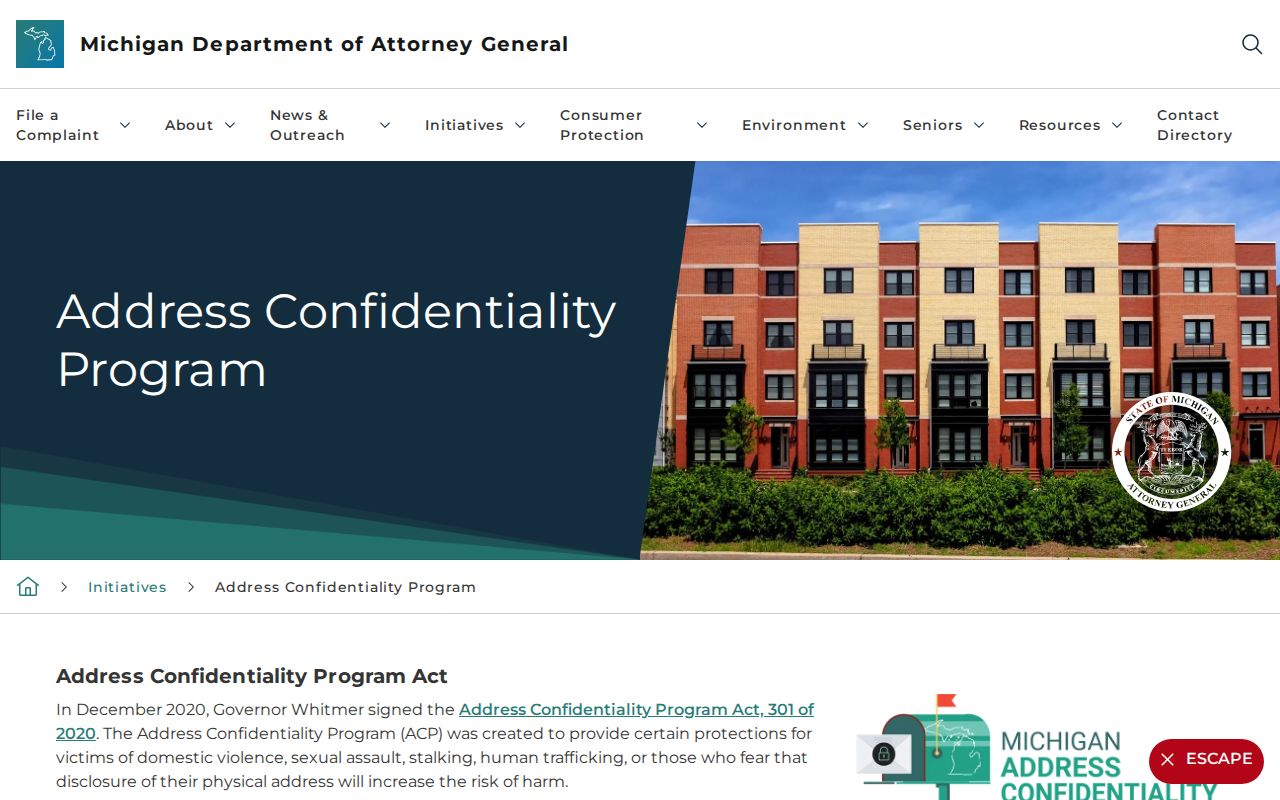
Michigan runs an Address Confidentiality Program. Participants get a designated address with mail forwarding. State and local agencies must accept it for program purposes. ACP information sits outside ordinary FOIA disclosure except as the law allows. Never use a public parcel record to infer or expose a protected physical location.
The image below shows the Attorney General's ACP page. Its official description covers designated-address protection and the program's public-record limits.
Note: Copy only the fields needed to compare the parcel and public record, leaving out signatures, account numbers, full birth dates, and protected addresses.